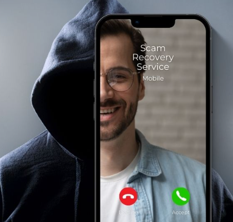
PROJECT: THE PSYCHOLOGICAL HOLD SCAMMERS CAN HAVE OVER THEIR VICTIMS
PLEASE SHARE THIS PUBLIC DOCUMENT
WHY VICTIMS SOMETIMES CONTINUE TO BELIEVE THE SCAMMER
One of the most difficult aspects of fraud investigations is understanding why an apparently intelligent
and capable person may continue communicating with a scammer, sending money or defending the person responsible,
even after family members and friends have identified obvious warning signs.
The explanation is not necessarily that the victim is gullible or unintelligent.
Sophisticated scammers deliberately manipulate trust, emotions, fear, hope and dependency.
Over time, these tactics can create a powerful psychological hold over the victim.
THE SCAM OFTEN BEGINS WITH TRUST:
Most scammers do not begin by asking for substantial amounts of money.
They first establish contact and build credibility.
They may present themselves as caring, successful, trustworthy or genuinely interested in the victim. In romance scams, the criminal may spend weeks or months developing what the victim believes to be a genuine emotional relationship.
The victim is therefore not simply responding to a stranger asking for money.
The victim may believe that the request is coming from someone they know and trust.
EMOTIONAL ATTACHMENT CAN OVERRIDE LOGIC:
Once emotional attachment has developed, contradictory information can become difficult for the victim to accept.
Family members may present evidence showing that photographs are false, identities do not match, stories are inconsistent or money is being diverted to suspicious accounts.
Yet the victim may continue believing the scammer.
This can occur because accepting the truth also means accepting that a relationship, friendship or future they believed in was fabricated.
The psychological loss can therefore become as significant as the financial loss.
SECRECY STRENGTHENS THE SCAMMER'S POSITION:
Scammers frequently encourage secrecy.
A victim may be told that family members do not understand the relationship, that the transaction is confidential, that revealing information could jeopardise an investigation, or that nobody else can be trusted.
Once secrecy has been established, the scammer can operate with less interference.
The victim may stop discussing the matter with family and may begin protecting the scammer from those attempting to help.
FEAR AND URGENCY REDUCE CRITICAL THINKING:
Scammers also create situations in which the victim believes that immediate action is necessary.
The victim may be told that an account will be frozen, an arrest will occur, an investment will be lost, a loved one is in danger or an opportunity will disappear unless money is transferred immediately.
Under pressure, people can make decisions they would reconsider if given time to verify the information independently.
THE SUNK-COST TRAP:
Financial loss can create another powerful form of psychological pressure.
After a victim has already transferred a substantial amount of money, accepting that the money is gone can be extremely difficult.
The scammer may therefore introduce another payment and promise that it will be the final amount required to release funds, pay taxes, clear customs, obtain a certificate or complete a transaction.
The victim may continue paying because stopping means accepting that previous payments were also lost.
This creates a cycle in which previous losses become a reason to risk further losses.
HOPE CAN KEEP A VICTIM ENGAGED:
Hope is one of the strongest tools available to a scammer.
The victim may believe that the next payment will result in the promised relationship, financial return, inheritance, business opportunity or recovery of previously lost money.
As long as the promised outcome remains possible in the victim's mind, the scammer can continue exploiting that hope.
WHY FAMILY INTERVENTION CAN FAIL:
Family members often approach the victim with understandable anger and frustration.
Statements such as “How can you still believe this person?” or “We have told you that this is a scam” may be factually correct but can cause the victim to become defensive.
If the victim feels humiliated or judged, they may withdraw further and communicate even more closely with the scammer.
The objective should therefore be to protect the victim without attacking the victim.
Evidence should be documented, inconsistencies should be identified and independent verification should be encouraged.
THE SCAMMER MAY ALSO CONDITION THE VICTIM:
Repeated communication can gradually normalise behaviour that would initially have appeared suspicious.
Small requests can become larger requests. One payment can become several.
A request for basic information can progress to identity documents, banking information or access credentials.
Because each step follows the previous one, the victim may not recognise how far the situation has progressed.
WHAT SHOULD FAMILIES DO?
When a person is suspected of being manipulated by a scammer, family members should:
preserve messages, emails, photographs and other evidence;
document payments and banking details;
avoid deleting communications before they can be preserved;
encourage independent verification of the scammer's identity and claims;
involve the victim in examining the evidence;
avoid unnecessary humiliation or confrontation;
contact the victim's bank immediately where financial information or funds are at risk;
report suspected criminal conduct to SAPS; and
obtain professional assistance where the victim is being repeatedly targeted or significant financial or identity-related harm has occurred.
If the victim has already lost money, particular caution should be exercised when someone subsequently offers to recover the money for a fee. Previous victims are known targets for further fraud, including recovery scams.
The psychological hold created by a sophisticated scam can be stronger
than simply telling a victim that the person on the other side is a criminal.
Scammers exploit normal human characteristics — trust, affection, hope, fear, loyalty
and the reluctance to accept a painful loss.
Understanding this is important for families, investigators and the public.
A victim should not be treated as the offender.
The responsibility for the deception lies with the perpetrator.
However, once warning signs emerge, continued engagement gives the scammer additional opportunities
to manipulate the victim and obtain further information or money.
Early intervention, preservation of evidence, independent verification and professional investigation
can help break the cycle and prevent further victimisation.
Specialised Security Services (SSS) encourages persons who suspect that they or a family member are being targeted
by an organised scam to preserve all available evidence and seek appropriate assistance.
SSS Specialist Investigators can investigate the circumstances, establish available evidence and assist in identifying
the methods being used to target the victim.
RELEVANT SSS PROJECTS:
Specialised Security Services invites the public to the Mike Bolhuis Daily Projects WhatsApp Channel.
This channel is important in delivering insights into the latest crime trends, awareness, warnings and the exposure of criminals.
How to Join the WhatsApp Channel:
1. Make sure you have the latest version of WhatsApp on your device.
2. Click on the link below to join the Mike Bolhuis Daily Projects WhatsApp Channel:
3. Follow the prompts to join the channel.
4. Make sure you click on "Follow", then click on the "bell"-icon (🔔)
CONTACT MR MIKE BOLHUIS FOR SAFETY AND SECURITY MEASURES, PROTECTION, OR AN INVESTIGATION IF NEEDED.
ALL INFORMATION RECEIVED WILL BE TREATED IN THE STRICTEST CONFIDENTIALITY AND EVERY IDENTITY WILL BE PROTECTED.
Regards,
Mike Bolhuis
Specialist Investigators into
Serious Violent, Serious Economic Crimes & Serious Cybercrimes
PSIRA Reg. 1590364/421949
Mobile: +27 82 447 6116
E-mail: mike@mikebolhuis.co.za
Fax: 086 585 4924
Follow us on Facebook to view our projects -
EXTREMELY IMPORTANT: All potential clients need to be aware that owing to the nature of our work as specialist investigators there are people who have been caught on the wrong side of the law - who are trying to discredit me - Mike Bolhuis and my organisation Specialised Security Services - to get themselves off the hook. This retaliation happens on social media and creates doubt about our integrity and ability. Doubt created on social media platforms is both unwarranted and untrue. We strongly recommend that you make up your minds concerning me and our organisation only after considering all the factual information - to the exclusion of hearsay and assumptions. Furthermore, you are welcome to address your concerns directly with me should you still be unsatisfied with your conclusions. While the internet provides a lot of valuable information, it is also a platform that distributes a lot of false information. The distribution of false information, fake news, slander and hate speech constitutes a crime that can be prosecuted by law. Your own research discretion and discernment are imperative when choosing what and what not to believe.
STANDARD RULES APPLY: Upon appointment, we require a formal mandate with detailed instructions. Please take note that should you not make use of our services – you may not under any circumstance use my name or the name of my organisation as a means to achieve whatever end.
POPI ACT 4 of 2013 South Africa: Mike Bolhuis' "Specialised Security Services" falls under Section 6 of the act. Read more here: https://mikebh.link/fntdpv
SSS TASK TEAM:

Copyright © 2015- PRESENT | Mike Bolhuis Specialised Security Services | All rights reserved.
Our mailing address is:
Mike Bolhuis Specialised Security Services
PO Box 15075 Lynn East
Pretoria, Gauteng 0039
South Africa
Add us to your address book
THIS PUBLIC DOCUMENT WAS INTENDED TO BE SHARED, PLEASE DO SO.