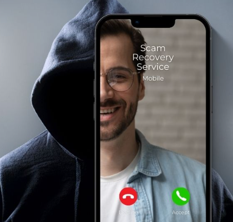

PROJECT: HOW TO IDENTIFY A SCAM CALLER
PLEASE SHARE THIS PUBLIC DOCUMENT
RECOGNISING THE WARNING SIGNS BEFORE YOU BECOME A VICTIM
Telephone scams remain an effective method of obtaining personal information, accessing financial accounts
and manipulating people into transferring money. Criminals may impersonate bank employees, police officers,
government officials, insurance representatives, courier companies, technical support staff or people known to the victim.
They often use carefully prepared scripts, publicly available personal information
and psychological pressure to make their calls appear legitimate.
In South Africa, callers may also use caller ID spoofing, where the number displayed on a recipient’s phone
is manipulated to resemble a trusted organisation or legitimate telephone number.
A familiar number, professional manner
or convincing explanation does not establish the caller’s identity.
Members of the public must therefore assess the circumstances of a call, recognise suspicious behaviour
and verify claims independently before disclosing information or taking action.
1. RECOGNISING THE WARNING SIGNS:
Scam callers use different approaches, but several warning signs occur repeatedly.
Unexpected requests for personal or banking information:
A caller asks for your identity number, banking details, card information, online banking password, PIN or one-time password (OTP).
Treat requests to disclose passwords, PINs or OTPs as serious warning signs, particularly when the caller claims that the information is required to secure your account.
Urgency and intimidation:
The caller claims that your account will be frozen, your money will be lost, a warrant will be issued, a parcel will be withheld or legal action will follow unless you act immediately.
The intention may be to prevent you from thinking clearly or checking the claim.
Requests to move money:
Someone claiming to represent your bank instructs you to transfer money to a so-called safe account, reverse a transaction, make an urgent payment or withdraw cash for collection.
A request of this nature must be independently verified before any action is taken.
Requests for remote access:
The caller instructs you to install an application, share your screen or allow remote access to your phone or computer.
Criminals can use these methods to observe sensitive information, manipulate banking sessions or gain access to accounts.
Suspicious links and verification procedures:
The caller sends a link by SMS or WhatsApp and asks you to log in, confirm your identity or update your banking information.
The link may lead to a fraudulent website designed to capture login credentials or personal data.
Unsolicited prizes, refunds or investments:
You are told that you have won a competition you did not enter, qualify for an unexpected refund or have access to a guaranteed investment opportunity.
The caller may demand an upfront fee, personal information or an immediate payment to release the supposed benefit.
Inconsistent or evasive answers:
When asked to explain the purpose of the call, provide verifiable details or allow you to contact the organisation independently, the caller becomes defensive, changes the subject or increases the pressure.
No single warning sign proves that a call is fraudulent. However, a combination of unexpected contact, secrecy, pressure and requests for sensitive information or money should prompt you to end the call and verify the matter independently.
2. HOW CRIMINALS MAKE THEIR CALLS SOUND LEGITIMATE:
Scam callers may know your name, telephone number, employer, bank or other personal details. This information may have been obtained through data breaches, social media, compromised accounts, previous scams or publicly accessible records. Knowing these details does not prove that the caller is genuine.
Criminals may also imitate the language, procedures and branding of legitimate institutions. Some use background noise resembling a call centre, transfer victims between supposed departments or arrange for another person to confirm the original caller’s story. These tactics create the impression that a formal process is underway.
Caller ID spoofing can make the call appear to originate from a recognised bank, government department or local telephone number. Even a number that appears to belong to a legitimate organisation can be misleading. Voice familiarity is also insufficient because criminals may impersonate people you know or use recordings and artificial intelligence to imitate a person's voice.
The correct response is to verify the caller through a separate, trusted communication channel rather than relying on the information or contact details supplied during the call.
3. QUESTIONS TO ASK A SUSPICIOUS CALLER:
If you are uncertain about a caller's identity, remain calm and avoid confirming additional personal information. You may ask:
Which organisation do you represent, and what is the purpose of your call?
Can I contact your organisation through its officially published telephone number to verify this matter?
What reference number can I use when contacting the organisation independently?
A legitimate representative should not need you to surrender control of your banking account or disclose confidential authentication details to prove your identity.
Do not rely on a telephone number, email address or website supplied by the caller. End the call and obtain the organisation's contact details from its official website, a trusted statement, the back of your bank card or another independently verified source. If you suspect a caller is impersonating your bank, contact the bank directly using a trusted number.
4. PRACTICAL STEPS TO PROTECT YOURSELF:
Members of the public should adopt the following precautions:
Pause before responding. Do not allow threats, deadlines or emotional pressure to dictate your actions.
Never disclose confidential authentication details. Do not reveal your PIN, password or OTP to a caller, and do not approve an authentication request you did not initiate.
End suspicious calls. You are not obliged to remain on the line or explain why you are ending the conversation.
Verify independently. Contact the relevant organisation using an independently sourced, trusted telephone number.
Do not transfer money on instruction from an unexpected caller. Verify any claimed fraud investigation, account problem or payment request directly with your bank.
Never grant unsolicited remote access. Do not install software or share your screen at the request of an unverified caller.
Limit personal information online. Publicly available details can help criminals construct convincing impersonations and targeted scams.
Warn vulnerable family members. Older persons, inexperienced technology users and people under financial or emotional pressure may need additional support when assessing unexpected calls.
5. WHAT TO DO IF YOU HAVE ALREADY RESPONDED:
If you disclosed banking information, approved a transaction, installed remote-access software or transferred money, act immediately.
Contact your bank through its official fraud-reporting channel and request that affected accounts, cards or digital banking access be secured. Change compromised passwords from a trusted device, revoke suspicious access and contact the relevant service provider if your phone or email account may have been compromised.
Preserve the evidence, including the telephone number displayed, date and time of the call, messages, links, payment details, transaction references and any recordings lawfully obtained. Do not delete relevant communications before preserving them.
Report suspected criminal conduct to the South African Police Service (SAPS) and obtain a case number where appropriate. You may also report suspected fraud to the impersonated organisation and the relevant service provider. If money has been transferred, notify your bank immediately; recovery is not guaranteed, but a prompt report may improve the opportunity to intervene.
Do not pay a person who promises to recover your stolen money in exchange for an upfront fee without independently verifying their legitimacy. Victims are frequently targeted again by criminals posing as investigators, lawyers, recovery agents or officials who claim they can retrieve lost funds.
6. PUBLIC RESPONSIBILITY AND PREVENTION:
Members of the public should avoid posting unverified accusations or identifying private individuals as scammers based solely on a telephone number or an online report. Numbers can be spoofed, reassigned or used without the registered subscriber's knowledge. Report the available evidence through appropriate channels and allow the matter to be assessed. Where a suspicious call is reported, record the facts accurately and distinguish what was personally experienced from what another person has reported. Never confront or threaten a suspected criminal, and do not attempt to conduct a private investigation that could expose you to further risk.
Identifying a scam caller requires caution, independent verification and an understanding of the methods criminals use
to obtain money or confidential information. A caller may sound professional, know personal details or display
a familiar telephone number without being who they claim to be. The most reliable safeguard is to refuse pressure,
protect authentication details, end suspicious calls and contact the relevant organisation through a trusted channel.
If a caller demands secrecy, immediate payment, confidential security codes or control of your device, stop the interaction
and verify the claim independently. A few minutes spent checking a caller's identity can prevent financial loss,
identity theft and further criminal exploitation.
Mr. Mike Bolhuis and the SSS Specialist Investigators urge the public to remain vigilant,
preserve evidence and report suspected scams through appropriate channels.
RELEVANT SSS PROJECTS:
Specialised Security Services invites the public to the Mike Bolhuis Daily Projects WhatsApp Channel.
This channel is important in delivering insights into the latest crime trends, awareness, warnings and the exposure of criminals.
How to Join the WhatsApp Channel:
1. Make sure you have the latest version of WhatsApp on your device.
2. Click on the link below to join the Mike Bolhuis Daily Projects WhatsApp Channel:
3. Follow the prompts to join the channel.
4. Make sure you click on "Follow", then click on the "bell"-icon (🔔)
CONTACT MR MIKE BOLHUIS FOR SAFETY AND SECURITY MEASURES, PROTECTION, OR AN INVESTIGATION IF NEEDED.
ALL INFORMATION RECEIVED WILL BE TREATED IN THE STRICTEST CONFIDENTIALITY AND EVERY IDENTITY WILL BE PROTECTED.
Regards,
Mike Bolhuis
Specialist Investigators into
Serious Violent, Serious Economic Crimes & Serious Cybercrimes
PSIRA Reg. 1590364/421949
Mobile: +27 82 447 6116
E-mail: mike@mikebolhuis.co.za
Fax: 086 585 4924
Follow us on Facebook to view our projects -
EXTREMELY IMPORTANT: All potential clients need to be aware that owing to the nature of our work as specialist investigators there are people who have been caught on the wrong side of the law - who are trying to discredit me - Mike Bolhuis and my organisation Specialised Security Services - to get themselves off the hook. This retaliation happens on social media and creates doubt about our integrity and ability. Doubt created on social media platforms is both unwarranted and untrue. We strongly recommend that you make up your minds concerning me and our organisation only after considering all the factual information - to the exclusion of hearsay and assumptions. Furthermore, you are welcome to address your concerns directly with me should you still be unsatisfied with your conclusions. While the internet provides a lot of valuable information, it is also a platform that distributes a lot of false information. The distribution of false information, fake news, slander and hate speech constitutes a crime that can be prosecuted by law. Your own research discretion and discernment are imperative when choosing what and what not to believe.
STANDARD RULES APPLY: Upon appointment, we require a formal mandate with detailed instructions. Please take note that should you not make use of our services – you may not under any circumstance use my name or the name of my organisation as a means to achieve whatever end.
POPI ACT 4 of 2013 South Africa: Mike Bolhuis' "Specialised Security Services" falls under Section 6 of the act. Read more here: https://mikebh.link/fntdpv
SSS TASK TEAM:

Copyright © 2015- PRESENT | Mike Bolhuis Specialised Security Services | All rights reserved.
Our mailing address is:
Mike Bolhuis Specialised Security Services
PO Box 15075 Lynn East
Pretoria, Gauteng 0039
South Africa
Add us to your address book
THIS PUBLIC DOCUMENT WAS INTENDED TO BE SHARED, PLEASE DO SO.